Company & Product
Celebrating Big Milestones with Todd Bernath
To celebrate working with over 1,000 clinics worldwide, we look back and reflect with our very first customer.
Discover how OptiPlan helps clinics reduce manual optimization, improve planning consistency, and adapt to growing clinical demands.
Modern radiotherapy has never been more capable or more complex. As techniques such as VMAT, stereotactic treatments, and adaptive radiotherapy become routine, clinics are expected to produce increasingly sophisticated plans while managing growing patient volumes and persistent staffing shortages.
How can automation help clinical teams deliver consistently high-quality plans while preserving the flexibility and judgment that every patient deserves? That question is central to OptiPlan, Radformation's new automated VMAT planning solution.

We recently introduced our latest automated planning tool at AAMD 's 2026 Annual Meeting and followed it with a live webinar demonstration. The conversations that followed reinforced something we've been hearing frequently: clinics are excited about the potential of automated planning.
With over 1,400 departments across the globe using EZFluence, there may be familiarity with its approach to autoplanning for 3D or forward-planned cases, like field-in-field or electronic compensation. For departments already familiar with EZFluence, the easiest way to understand OptiPlan is through a simple analogy:
OptiPlan : VMAT :: EZFluence : 3D Planning
Just as EZFluence automates the routine aspects of 3D planning to produce consistent, reliable outputs, OptiPlan automates VMAT optimization to help create high-quality treatment plans while reducing the manual iteration traditionally required during planning.
The similarities don’t end there.
Like EZFluence, OptiPlan launches as a published script within the Eclipse™ treatment planning system, leverages the native Eclipse optimization and dose calculation engines, and provides intuitive slider controls that allow planners to fine-tune plan priorities when needed. Rather than replacing the planner, its goal is to reduce repetitive optimization work, allowing clinicians to focus on plan evaluation and patient-specific decision-making.
Together, EZFluence with the optional OptiPlan module automates key aspects of 3D, field-in-field, electronic compensation, and VMAT cases, covering a considerable portion of clinical planning needs.
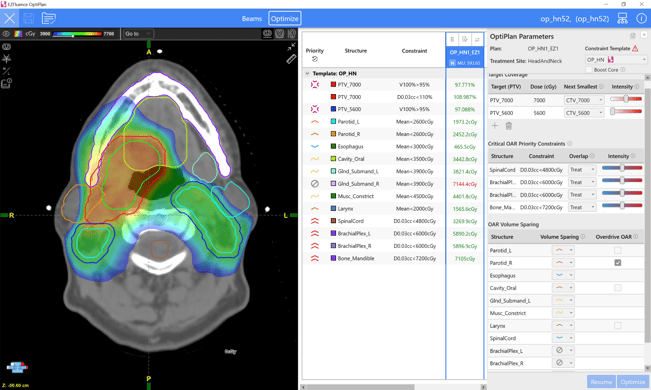
The user-friendly interface allows for 3D plan dose visualization, ClearCheck constraint analysis, plan comparison, and plan customization tools.
In designing intelligent automation tools, we carefully consider how the software integrates into the day-to-day workflow for the end user. In this case, we aim to improve consistency, reduce manual effort, and simplify the optimization process. OptiPlan supports these goals by:
The goal is to create high-quality, clinic-ready plans comparable to those generated by the best manual planners, without extensive implementation resources. Standardizing the approach via automation allows for the reduction in plan output variability among planners or institutions. And because no plan models are necessary, like with other automated planning tools, it can be used “out of the box” and can adapt to changes in practice guidelines or new treatment protocols with minimal effort.
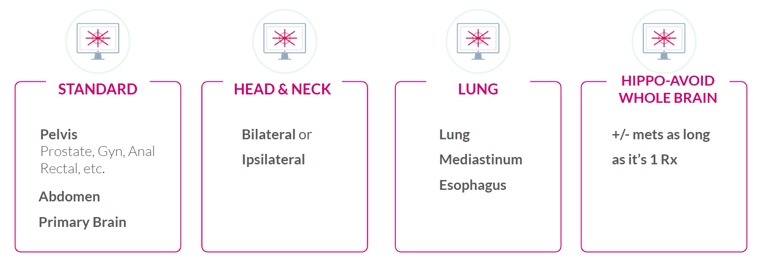
OptiPlan is designed to generate high-quality VMAT plans across a broad range of commonly treated disease sites. By balancing target coverage, dose homogeneity, and organ-at-risk (OAR) sparing, it supports planning for head and neck, thoracic, abdominal, pelvic, brain, and hippocampal avoidance (HA) whole-brain treatments. With support for up to four unique dose levels, many common indications treated with VMAT are supported with this approach.
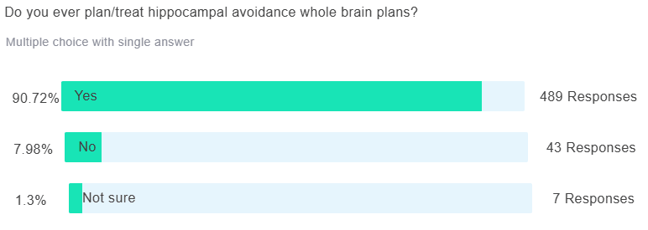
One example is hippocampal avoidance whole-brain radiotherapy, which has become an increasingly common technique for helping preserve neurocognitive function while maintaining disease control. In a recent Radformation webinar, more than 90% of respondents indicated they currently perform, or have previously performed, HA whole-brain planning, highlighting the growing adoption of this clinically important treatment approach.
Unlike automated planning approaches that rely on models trained from large libraries of historical treatment plans, OptiPlan is designed around your institution's existing ClearCheck templates. Rather than adopting the planning style of the institution that generated a training dataset, clinics can use their own optimization objectives and clinical priorities with minimal implementation effort and without the need for model training or ongoing model maintenance.
Just as importantly, every patient presents unique anatomical and clinical challenges, and treatment plans often require thoughtful tradeoffs between target coverage and normal tissue sparing. OptiPlan is designed to maximize target coverage while respecting critical dose constraints, even in challenging overlap scenarios where targets and organs at risk compete. The result is an automated workflow that provides a consistent starting point that clinicians can review and refine as needed.
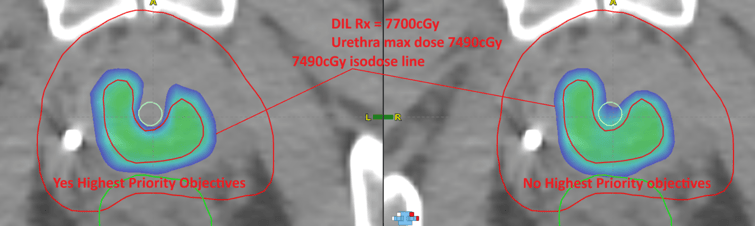
Discrete structure optimization values allow for flexibility in prioritization of clinical goals. In this prostate example, the left image shows urethra sparing, while the right image shows a dose distribution that favors target coverage.
To better understand OptiPlan's performance, Radformation conducted a limited preclinical comparison using the dataset from the 2017 ProKnow Head and Neck Challenge. Five experienced dosimetrists and medical physicists from the Radformation team independently created treatment plans under clinically realistic conditions, using between two and four arcs and a maximum planning time of six hours.
The plans were evaluated against the ProKnow scoring rubric, which assigned point values to critical plan dose metrics for target coverage, conformality, and OAR sparing. On average, manually generated plans took a little over three hours to complete, used 2-3 arcs, and used 538 MUs. Out of an available 150 points, the total score averaged 132.2 for manual plans. This compares to 136.6 for the OptiPlan automated plan—outperforming all manual plans—which used 684 MU and was completed in 45 minutes (3-4 minutes of human input with the remainder running in the background) using the same hardware resources.
Unlike manual planning, where planners remain actively engaged throughout much of the optimization process, OptiPlan automatically performs multiple optimization and calculation iterations to generate a VMAT plan. While this process is running, planners are free to continue with other clinical tasks, allowing more productive use of their time. The total optimization time will vary depending on factors such as workstation hardware, network performance, and Eclipse system configuration, but the active planner time required is significantly reduced.
While the preliminary plan challenge comparison is inherently limited, it demonstrates the potential for efficient, high-quality plans that achieve demanding clinical goals.
OptiPlan is more than just a great new tool for treatment planners. It’s a bold step in the direction towards addressing three key challenges facing the field of radiation oncology, broadly speaking:
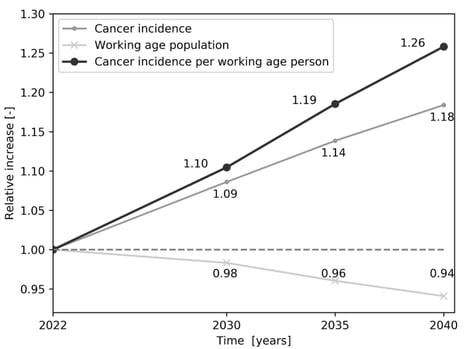
This figure from Petit, et. al, illustrates the projected increase in cancer incidence in Europe through 2040. Compounding the demand is a trend in the opposite direction with declining workforce populations.
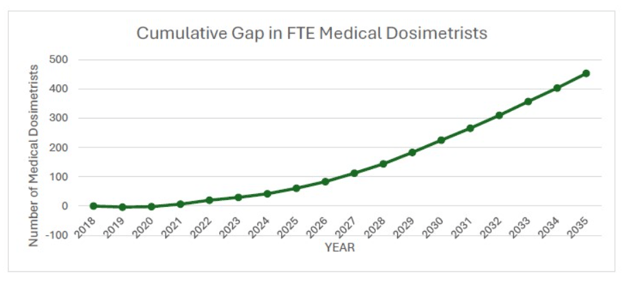
A 2020 AAMD Workforce Study shows a projected gap in medical dosimetrists through 2035.
As we’ve seen, demand for radiotherapy is increasing while the staff to provide care is under stress. There is another clinical trend further compounding the challenge: plans are increasing in complexity. According to a 2020 article from Malouff, et. al6 regarding prostate cancer radiation therapy:
This trend applies well beyond prostate indications. The widespread adoption of IMRT, VMAT, SBRT, adaptive radiotherapy, and hypofractionated treatment regimens has increased the technical complexity of radiation therapy planning and delivery. These treatments require tighter margins, greater dosimetric precision, more sophisticated treatment planning, and more rigorous quality assurance than conventional fractionation, placing greater demands on clinical workflows and QA processes.
The challenges facing radiation oncology are unlikely to become simpler. Demand for radiotherapy continues to rise, workforce shortages are projected to persist, and treatment planning continues to grow in complexity as new techniques and clinical protocols continue to evolve.
No single technology will solve these challenges, but thoughtfully applied automation can help departments use their clinical expertise more effectively. In fact, Petit et al.1 identified automation of clinical tasks, including autocontouring and automated treatment planning, as one of several meaningful interventions that can help bridge the growing gap between demand for radiotherapy services and the clinical resources available to deliver them.
The value of automation, however, extends beyond efficiency. The best automation doesn't replace clinical expertise. Instead, it amplifies it. By reducing the repetitive, iterative work involved in VMAT optimization, treatment planners can spend more time evaluating plan quality, making patient-specific clinical decisions, collaborating with physicians, and focusing on the most demanding cases. At the same time, automation helps improve consistency by reducing planner-to-planner variability and capturing institutional best practices, giving every patient a strong starting point while still allowing clinicians the flexibility to individualize care when needed.
OptiPlan automates VMAT optimization while preserving the flexibility to adapt to individual patients, evolving treatment techniques, and new clinical guidance. Because it is not dependent on a library of historical training plans, departments can refine and evolve their own planning approach over time without rebuilding or retraining a model.
Most importantly, our approach to automated planning keeps clinical decision-making exactly where it belongs: with qualified radiation oncology professionals. It does not prescribe dose, determine clinical priorities, or approve treatment plans. Instead, it provides a high-quality candidate plan that clinicians can evaluate, refine, and approve using their own expertise and judgment.
Radiation oncology has always advanced through innovations that help clinicians deliver better patient care. OptiPlan continues that tradition by bringing practical, workflow-focused automation to VMAT planning, helping departments improve consistency, reduce manual effort, and make the most of their valuable clinical expertise.
Want to see what OptiPlan can do for your workflows?
To learn more about the future of automated VMAT planning, schedule a call with one of our experts today.
*OptiPlan is an optional module of EZFluence, requires ClearCheck, and currently supports Eclipse only. EZFluence with OptiPlan is US FDA 510(k) pending (K261718), and CE Marked and available where CE Mark is recognized.
References

Leave a comment